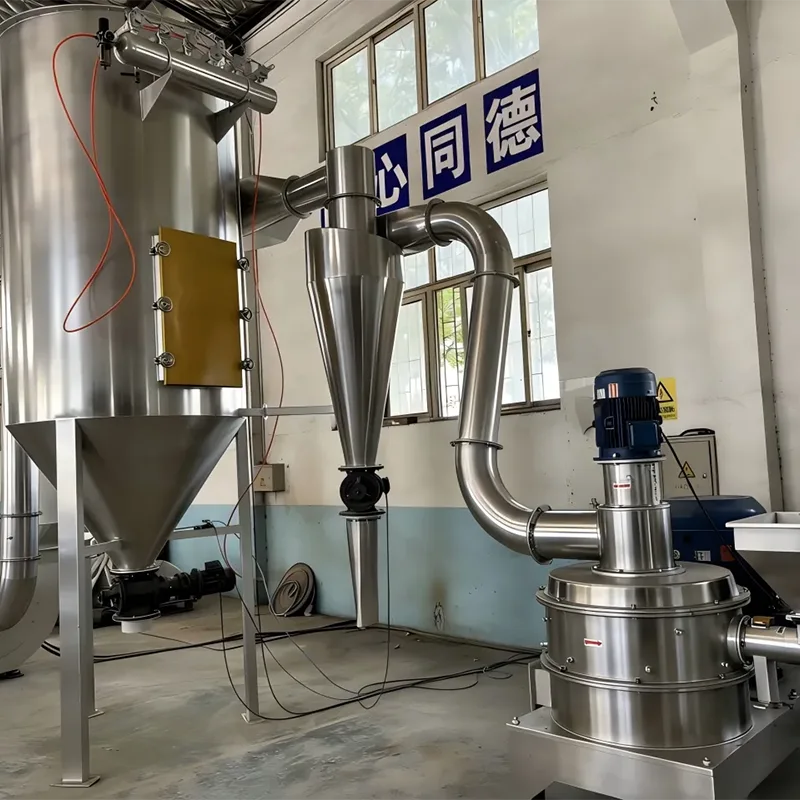
Chili powder is widely used in hotpot bases, chili oil, seasoning blends, instant noodle flavorings and other food products. Different applications may require different levels of fineness, color consistency and processing capacity. For spice processors, selecting grinding equipment means balancing these production requirements rather than focusing on output volume alone.

Why Temperature Matters in Chili Grinding
During mechanical grinding, impact and friction can raise the temperature of the material. For dried chili peppers, excessive heat may affect natural pigments and volatile aroma compounds, potentially changing the appearance and sensory properties of the finished powder.
The XSW Chili Ultrafine Pulverizer uses a low-temperature grinding approach intended to help preserve chili color, pungency and aroma. Actual results depend on the raw material, moisture content, feed rate, equipment settings and operating conditions.
Four Factors That Influence Chili Powder Quality
01. Color Retention
Grinding temperature and processing time can influence the appearance of chili powder. Low-temperature processing is designed to reduce heat-related changes to the material.
02. Particle Uniformity
Air classification separates particles according to the configured fineness. This helps processors target a more consistent particle-size distribution for downstream blending and packaging.
03. Dust Containment
A sealed negative-pressure arrangement and dust collection system help contain fine powder during operation and reduce airborne dust in the processing area.
04. Raw Material Handling
Chili skins and seeds contain fibrous material. Feed size, moisture, feeding rate and material composition should be considered when configuring the grinding process.
Equipment Specifications at a Glance
The product page lists four model options with different motor powers, rotor speeds, feed-size limits and output-fineness ranges. The specifications below are intended for preliminary comparison. Confirm the exact configuration and expected output with the supplier before ordering.
| Parameter | Available Specification |
|---|---|
| Model | XSW35-18.5 / XSW50-45 / XSW75-75 / XSW95-110 |
| Main Motor Power | 18.5 kW / 45 kW / 75 kW / 110 kW |
| Grinding Wheel Speed | 4500–5200 / 3800–4500 / 3000–3600 / 2200–2800 rpm, respectively |
| Feed Size | ≤10 mm / ≤12 mm / ≤15 mm / ≤15 mm, respectively |
| Output Fineness | 60–320 mesh / 60–400 mesh / 60–500 mesh / 60–500 mesh, respectively |
| Contact Material | 304 stainless steel |
| Operation | Sealed negative-pressure operation with dust collection |
From Dried Chili to Classified Powder
The grinding and classification process can be divided into several stages. Each stage should be checked against the required output specification and the characteristics of the raw material.
Prepare the Raw Material
Check the chili's moisture content, cleanliness and feed size before grinding. The product page recommends pre-drying chili to a moisture content of 8% or below for processing.
Feed the Grinding Chamber
Introduce dried chili evenly and gradually. Excessive feeding may interfere with stable material flow through the crushing chamber and affect processing performance.
Grind and Classify
The rotor reduces the material through impact, shear and friction. An air classifier separates particles according to the configured fineness, allowing coarser material to return for further grinding.
Collect and Inspect the Powder
The collection system receives the classified powder. Operators should verify particle size and product appearance through sampling and suitable inspection methods before full-scale production.
Applications Across Spice Processing
Depending on the required fineness and production configuration, the equipment may be considered for a range of chili and spice powder applications.
Different applications may require different particle sizes. Fine powder for seasoning blends, for example, may have different flow and mixing requirements from coarser table chili powder. A sample test can help determine whether the selected model and classification settings are suitable.
Operating Checks for Consistent Production
Choosing a Suitable Model
Model selection should take into account the expected hourly throughput, required mesh range, raw material characteristics, available installation space and downstream production process. Motor power alone does not determine actual output; throughput should be confirmed for the intended chili variety and operating conditions.
Before selecting a machine, clarify the target particle size, raw material moisture, whether seeds will be included, and the expected production capacity. These details help establish whether a particular configuration can meet the processing requirements.
For further technical details about the Chili Ultrafine Pulverizer, review the listed specifications and discuss the intended application with XSW before confirming a configuration.
Discuss Your Chili Grinding Requirements
Share your raw material details, target particle size and estimated production capacity to help identify a suitable equipment configuration.
View Product Details